
Potter ÉCONOMUSÉE Designation

On June 19, 2026, Freba Pottery officially became an ÉCONOMUSÉE artisan site.
During the ribbon-cutting ceremony I had the opportunity to reflect on the journey that brought me here. The following are the remarks I shared with those gathered that day.

Good afternoon everyone,
Thank you so much for being here today.
I want to begin by saying how grateful I am to see so many people gathered here at Freba Pottery for this ÉCONOMUSÉE ribbon cutting. There are people here today from Prairies Can, WESK, Tourism Saskatchewan, the ÉCONOMUSÉE Network, CECS, the RM, the Town of Wynyard, local community members, family, friends, customers, and so many people who have supported this business in ways both big and small.
Je veux d’abord vous dire à quel point je suis reconnaissante de voir autant de personnes réunies ici, chez Freba Pottery, pour cette cérémonie d’inauguration de l’ÉCONOMUSÉE. Il y a aujourd’hui des représentants de Prairies Can, de WESK, de Tourisme Saskatchewan, du Réseau ÉCONOMUSÉE, de CECS, de la municipalité rurale, de la Ville de Wynyard, ainsi que des membres de la communauté locale, de ma famille, des amis, des clients, et tant de personnes qui ont soutenu cette entreprise, de grandes et de petites façons.
Today is important because this ribbon cutting represents years of work, community support, rural possibility, creative risk, and a whole lot of people saying yes at the right moments.
So today, I want to tell the story of how Freba Pottery got here.
At the very beginning, I just loved pottery.
But one of the most important moments in this whole story happened in 2003, long before there was a Freba Pottery highway store, long before Claycation, and long before I ever imagined standing here for an ÉCONOMUSÉE ribbon cutting.
That summer, I had been cycling on Salt Spring Island by myself when I received devastating news. Megan, a former student of mine who had graduated only two weeks earlier, had died in a car accident. I changed my plans and joined up with my cousins as I tried to process that grief.
We were travelling through Denman Island visiting pottery studios and following a map of studios on the island. We turned down a driveway that wove through a heavily forested area. We drove past an old VW van tucked into the trees that looked like it had become more environment than van, and we stopped in front of this building with a deck. We walked in and started looking around. There was a large room to one side and a smaller room to the other. There were a few other people there, and we were chatting, thinking one of them was probably the artist. Then we realized we were standing in an honour-system pottery store. Off the large room was a smaller area with a counter, a bowl of cash where you could make change, instructions for using an old credit card machine, paper, bags, and this incredible trust in humanity. I had to buy a piece of pottery. I bought a plate as a gift for my mom. That plate was around $40 in 2003. I could have bought a plate from the dollar store for $1, and both plates would have technically had the same function. They could both hold food. But the experience of buying them was completely different.
I did not hesitate to buy the $40 plate because of the experience. That 15-minute moment stayed with me. In a season of grief, that experience gave me something I did not have words for yet: beauty, trust, handmade work, and a sense of human connection.
It planted something.
That fall, when I came home, I started taking pottery classes. And all these years later, I can see that pottery entered my life not only as a creative interest, but as part of a healing journey.
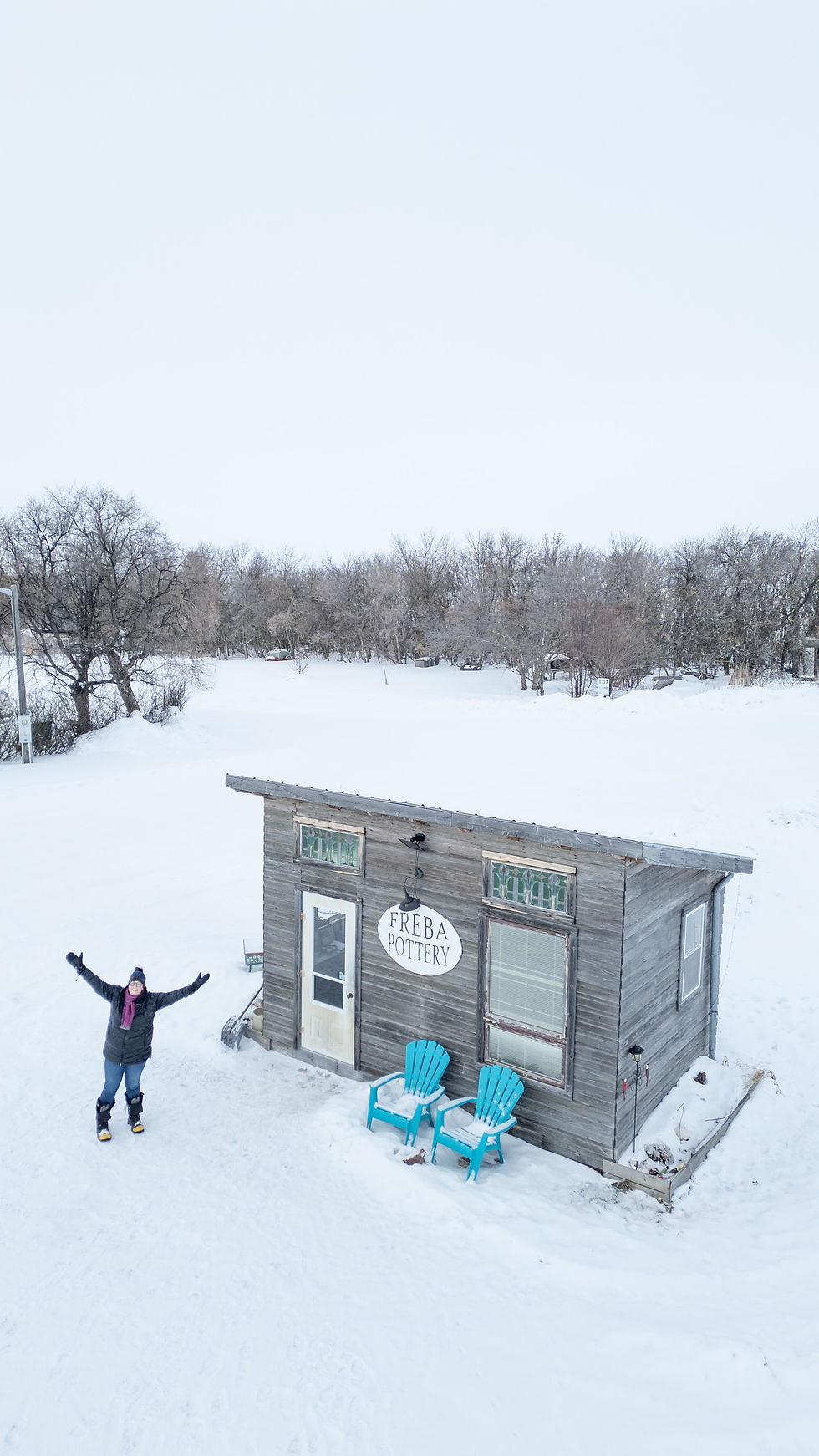
Ten years later, when we moved home to buy my Amma’s house , I was still teaching art and history, and I here I was making enough pottery that I could start to sell it and built the store - worst case scenario I could make pottery and substitute teach if I didn’t get a permanent teaching contract. I did get a teaching contract, but I still built the little pottery store. It was built out of wood from a machine shed in the yard, stained-glass windows that had belonged to my grandma and needed a home, and reclaimed windows and doors. It was rustic from the beginning. No heat. No power. Just pottery, trust, and a sign inviting people to use the honour system.
I had three goals that first summer.
I wanted to sell pottery to someone when I was not home.
I wanted to sell pottery to a semi driver who stopped.
And I wanted to sell pottery to someone travelling by motorcycle.
I accomplished those goals that first summer.
And then people kept coming.
The little highway store started as a practical idea. I was teaching full-time, raising a family, making pottery, and trying to find a way for this creative business to fit into real life. But I was also trying to recreate, in my own way, that experience I had on Denman Island — except here, in the middle of Saskatchewan, on the side of the Yellowhead Highway. Over the years, more and more people stopped, and they shared the story. CAA Magazine wrote an article. Ashlyn George visited when she was the Saskatchewanderer. CBC Radio shared the story. CTV came out. Other media opportunities followed. And maybe most importantly, word of mouth carried this place farther than I ever could have on my own. People were not just buying pottery. They were connecting to a story. They were connecting to a place. They were connecting to the idea that something handmade, rural, creative, and built on trust could matter.
People often ask me, “Have you had problems with people stealing?”
And I usually ask, “Would you steal from it?”
Most people immediately say, “Well, no.”
And that is the point.
The experience of being trusted to stop, shop, and pay is significantly different. It gives people a feeling of hope in humanity, the same way I felt on Denman Island. And if something ever does happen, I usually say, “Well, they must have really needed it, and at least they have good taste.”
I also like to say that organized crime is still too busy with pot; they have not gotten into pottery yet. But if my pottery starts being traded on the black market, then I guess society has shifted.
That trust has become part of the experience. Now when people stop at the highway store, they can pin where they are from on the maps and leave notes. I have had to take notes down every few years because there is no space left for more. I love looking at those maps and seeing where people have come from, and reading the little notes they leave behind.
Those notes are reminders that this place has become more than a store. It has become a story people participate in.
In 2017, traffic stopping at the store had increased enough that I went to 50 percent teaching and 50 percent pottery. Then Covid happened, and in a strange way, the honour-system store was built for that moment. People could come one carload at a time and shop safely. People were driving out from the city just to come to Freba Pottery. I realized I could no longer keep teaching full-time and doing pottery on the side. The pottery was no longer something happening around the edges of my life. It had become a business, a calling, and a way to welcome people into creativity. In the fall of 2021, after 25 years in education, I left teaching to do pottery full-time.
That was a huge decision. Teaching had been such a major part of my identity. I loved being an art teacher. I loved helping people see themselves as creative. But pottery had grown from something I loved into something that was asking for more space in my life.
But passion alone does not build a sustainable business. I knew I needed support, structure, and people who could help me think bigger. That is where programs like Propel through WESK and Achieving Awesome through Tourism Saskatchewan became so important. Through those programs, I was challenged to look at Freba Pottery not only as a pottery business, but as a visitor experience. I started to understand that what was happening here was not only retail. It was tourism. It was hospitality. It was storytelling. It was rural economic development. It was experiential learning. It was people coming to this place not just to buy something, but to feel something.
When I left teaching, I was encouraged to apply for Achieving Awesome through Tourism Saskatchewan (Corrina was very convincing) to develop another experience. I was a little in awe that this little honour-system pottery store had become a tourist destination.
In the fall of 2022, I participated in Achieving Awesome, and that helped me develop Elemental Claycation. Before Claycation, I had taught pottery classes in my studio once a week for eight weeks. People from the area would come and learn, but it meant shutting down my production studio every week. By about the fifth week, I realized that the experience was not working well for me. It interrupted my making rhythm, and it limited my audience to people close enough to drive weekly. So Elemental Claycation was born out of a need to change both the guest experience and my own experience of teaching.
I wanted to create a pottery experience where people could come for a weekend, stay in our heritage house, work in my studio, eat together, learn together, and be fully immersed in pottery and prairie hospitality. Instead of teaching weekly classes, I could shut down production once a month for a full retreat experience. We had an unfinished third-floor attic in our 1919 heritage house, and my dad and I began renovating that space in April of 2023. We turned it into a beautiful place where guests could sleep for the weekend. I can sleep six people in the attic, which is the largest group I can handle while still teaching wheel throwing one-on-one. I worked very, very hard to curate the weekend experience to be memorable and more than just a pottery class.
Elemental Claycation became an immersive pottery retreat where people come here to learn, create, eat together, stay together, and experience pottery in a deeper way. It is the only experience of its kind in Canada, and it has become such a meaningful part of Freba Pottery.
I launched Claycation in December of 2023. My original plan was to host about 10 a year, but the demand kept growing. In 2024, I hosted 12, and since launching have hosted 30 claycations. The tiny details matter to me. I want people to have experiences that are different from what they can find anywhere else. I love to travel and collect experiences, and so many of the touches in Claycation come from thinking carefully about hospitality. The drinks, snacks, products, beds, linens, and guest details are chosen intentionally. I try to prioritize women-owned first, Saskatchewan second, and Canadian third. For example, the duvets in the attic are wool duvets made right here in Saskatchewan. I could have gone to a big box store and bought blankets, but that would not tell the same story. I want guests to feel connected to this place, to Saskatchewan makers, to rural hospitality, and to the care behind the experience.
Claycation grew because people said yes. Guests said yes to trying something new. Tourism Saskatchewan said yes to supporting experiential tourism. WESK said yes to helping me strengthen the business side. Customers said yes every time they came through the highway store door. Friends and family said yes when I needed help with projects, renovations, meals, events, kiln loads, and all the invisible work that happens behind the scenes.
And I cannot tell this story without talking about my family.
Because when you are married to, raised by, or born to someone who says, “I have an idea,” you learn pretty quickly to buckle up. Around our house, “I have an idea” is not a sentence. It is a warning. My family has been part of every chapter of this journey. Every time Freba Pottery has grown, shifted, expanded, renovated, or become something new, they have been pulled into the orbit of another idea.
My dad, Eric Olafson, has been side by side with me through so many of the renovation projects and practical builds that have made this place possible. When I have a vision, he is often the one helping figure out how to actually make it stand up, fit together, and function. He has also become an expert in reclaiming clay and pugging clay for me, which means the clay that might otherwise be wasted gets worked back into something I can use to make new pieces. That work is not glamorous, but it is essential, and it is one of the ways he has quietly helped keep this business moving.
My husband, Brad, has supported me through all of my crazy ideas — including the very large idea that leaving a 25-year teaching career to become a full-time potter was somehow a good plan. He has believed in me, helped me, listened to me talk through every version of every idea, and stood beside me as this business has grown. Although I will admit, there may still be days when he wonders exactly how good of an idea it was to leave education he still supports me.
My girls, Freyja and Ebba, have grown up alongside this business. They are the Freba of Freba Pottery. They have done extra jobs, helped when I needed more hands, adjusted to busy seasons, and watched their mom build offerings that no one else was really doing. Claycation, the honour-system store, workshops, events, and now the ÉCONOMUSÉE — all of those things have required more than just my work. They have required family flexibility, family patience, and family support.
And my mom, Karen Olafson, gave me the love of pottery when I was very young. Our family collections of pottery, the pieces we loved, used, noticed, and treasured, all fed into my desire to become a potter. Long before I had a business, long before I had a studio, long before I knew this would become my life’s work, there was already an appreciation for handmade pottery in me because of her.
My nephew Gaige, got asked to change the flooring in the kitchen and hallway and as a result learnt how to refinish floors when we found amazing wood, do the inside finishing work on the School House Studio and has been living with us for the past 7 months taking carpentry in Humboldt. He built the new pergola behind the store - still has some more work to reach my vision, but has taken over many of the projects around the here carpentry wise.
So when people see Freba Pottery, I hope they understand that this has never been a one-person story. My name may be on the business, and I may be the one standing here today, but my family has helped shape, carry, build, encourage, and support this dream from the very beginning.
In May of 2024, the story changed again. An engineer called me about a passing lane planned in front of our property. Around that same time, Andrew, who was then the Saskatchewanderer, came out and created a reel about Freba Pottery. That reel went viral and reached around 1.5 million views. Suddenly, people everywhere were seeing the little honour-system pottery store on the Saskatchewan prairie. And then, as many of you know, I had to fight the Department of Highways. That was not a chapter I would have chosen. It was stressful, exhausting, and overwhelming. But something surprising happened in the middle of that difficult season. The exposure became incredible. More people learned about Freba Pottery. More people understood what this place meant, not only to me, but to the community and to the people who travel here.
People started recognizing me on the street. People were talking about the store, the business, the trust model, and the value of rural creative spaces. It was hard, but it also made something very clear: Freba Pottery mattered to people. While all of that was happening, Serge from CECS came out in November of 2024 to determine whether Freba Pottery could become an ÉCONOMUSÉE. That visit opened another door.
The ÉCONOMUSÉE model felt like such a natural fit because Freba Pottery has always been about more than the finished piece. It is about the process. It is about the maker. It is about learning how something is created. It is about connecting the public to craft, culture, heritage, and place. Pottery is one of the oldest human crafts. It connects us to earth, water, fire, and human hands. It connects function and beauty. It connects the past to the present.
To be recognized as part of the ÉCONOMUSÉE Network is an incredible honour because it places this little rural Saskatchewan pottery studio within a much larger story of artisans, heritage, tourism, and living craft. With the support of a development grant, the next part of the dream was to create a stand-alone studio — the Schoolhouse Studio. Originally, I wanted to move and restore an original one-room schoolhouse about seven miles east of our house. That idea felt meaningful to me because of my years as a teacher and because I still see teaching as central to what happens here. Even though I left the classroom, I never really stopped teaching. I just changed the classroom. It also connected to the history of this acreage. My Amma boarded in this house before 1938 while she taught in a one-room schoolhouse about a mile south of our property. I loved the idea of being a former teacher with a one-room schoolhouse studio. But as the project developed, the plan shifted. Remediating and moving the original schoolhouse would have cost about the same as building new. So instead, we built a garage package based on the footprint and feeling of a one-room schoolhouse. It became a practical version of a romantic idea.
It gave us a dedicated space for Claycations, workshops, teaching, making, welcoming guests, and telling the story of pottery in a way that could support the ÉCONOMUSÉE designation. That building went up on August 25.
And then, on September 11, I was hit by a truck. That is another part of this story that I would not have chosen. The last nine months have been hard. Physically, emotionally, and mentally, it has taken a lot to keep going. There have been days when I have had to adjust what I could do. There have been days when the work felt too big and my body felt too limited. There have been moments when I wondered how all of this was going to come together. But here we are.
Nine months later, we are cutting the ribbon on Freba Pottery’s ÉCONOMUSÉE designation.
And when I look around, I do not just see a building or signs or a completed project. I see resilience. I see community. I see every person who helped carry this forward when I could not carry it all myself. The signs that have been created for this designation are incredible. They help tell the story of pottery, of process, of place, and of Freba Pottery in a way that visitors can understand and experience. They make the invisible parts of the work visible. They invite people to slow down, learn, and see handmade pottery not just as a product, but as a living craft.
That is what excites me most about today. This designation connects the honour-system store, the Schoolhouse Studio, Claycation, workshops, and the story of pottery into one fuller experience. It allows visitors to understand not just what I make, but how and why it is made. It helps people see the clay, the process, the hands, the failures, the firing, the trust, the hospitality, and the place behind each piece. This designation creates possibilities. It creates possibilities for visitors to experience pottery in a deeper way. It creates possibilities for rural tourism in this area. It creates possibilities for partnerships, school visits, retreats, workshops, and creative experiences. It creates possibilities for people to understand that meaningful tourism does not only happen in big cities or obvious destinations. It can happen here, on the prairie, in a pottery studio, beside a highway, in a community like ours.
I also hope this project helps people see what is possible when we invest in rural creative businesses. Small businesses like this are not just places to buy things. They create reasons for people to stop. They bring visitors into communities. They support local restaurants, accommodations, events, gas stations, and other small businesses. They build pride of place. They give people stories to tell. The businesses that pay attention to the experience are the ones people talk about. I know I do not get it right 100 percent of the time, but I will keep growing and elevating the experience. I want people to choose my mug over the mass-produced mug because of their experience. I want them to know that when they use a piece of pottery I made, we are connected in some small way.
Freba Pottery has grown because of trust. It has grown because of creativity. It has grown because people believed in it before it was fully formed. And it has grown because this community, and the wider tourism and business community in Saskatchewan, has continued to open doors.
So I want to say thank you.
Thank you to WESK for helping me strengthen my business and believe that a creative rural business could grow with intention.
Thank you to Tourism Saskatchewan for helping me understand Freba Pottery as a visitor experience and for supporting the development of Claycation and experiential tourism.
Thank you to the ÉCONOMUSÉE Network for recognizing the value of this craft, this place, and this story.
Thank you to CECS, and especially to Serge, for seeing the potential here and helping move this designation forward.
Thank you to the RM and the Town of Wynyard for being part of the community that surrounds this business.
Thank you to the media who have shared this story over the years, from CAA Magazine to the Saskatchewanderers, CBC, CTV, and others.
Thank you to my customers, workshop participants, Claycation guests, and everyone who has ever stopped at the highway store, trusted the honour system, bought a mug, told a friend, shared a post, or brought someone here.
And once more, thank you to my family and friends, who know more than anyone how much work has gone into this. You have helped with building, cleaning, cooking, carrying, encouraging, problem-solving, and believing.
And thank you to everyone who is here today. Your presence matters.
Et merci à toutes les personnes qui sont ici aujourd’hui. Votre présence est importante.
When I think back to the beginning, I did not set out to build all of this. I just loved pottery.
But love, when you keep following it, can become something bigger than you imagined. It can become a business. It can become a destination. It can become a gathering place. It can become a story that other people feel part of. It can become a way to connect people to creativity, community, and place.
That is what Freba Pottery is to me. It is clay, yes. It is mugs and bowls and workshops and retreats. But more than that, it is connection through creativity.
And today, as we toast to the opening of Economusee , I am so grateful for everyone who has helped make that connection possible.
As I continue creating pottery, welcoming visitors to the highway store, teaching workshops, and hosting Claycations, I remain grateful for every person who has been part of this journey.
Thank you for helping make Freba Pottery what it is today!
Marea Olafson


Comments